
“Philosophical Discourse on Reforms and Development succesfully conducted by the students”
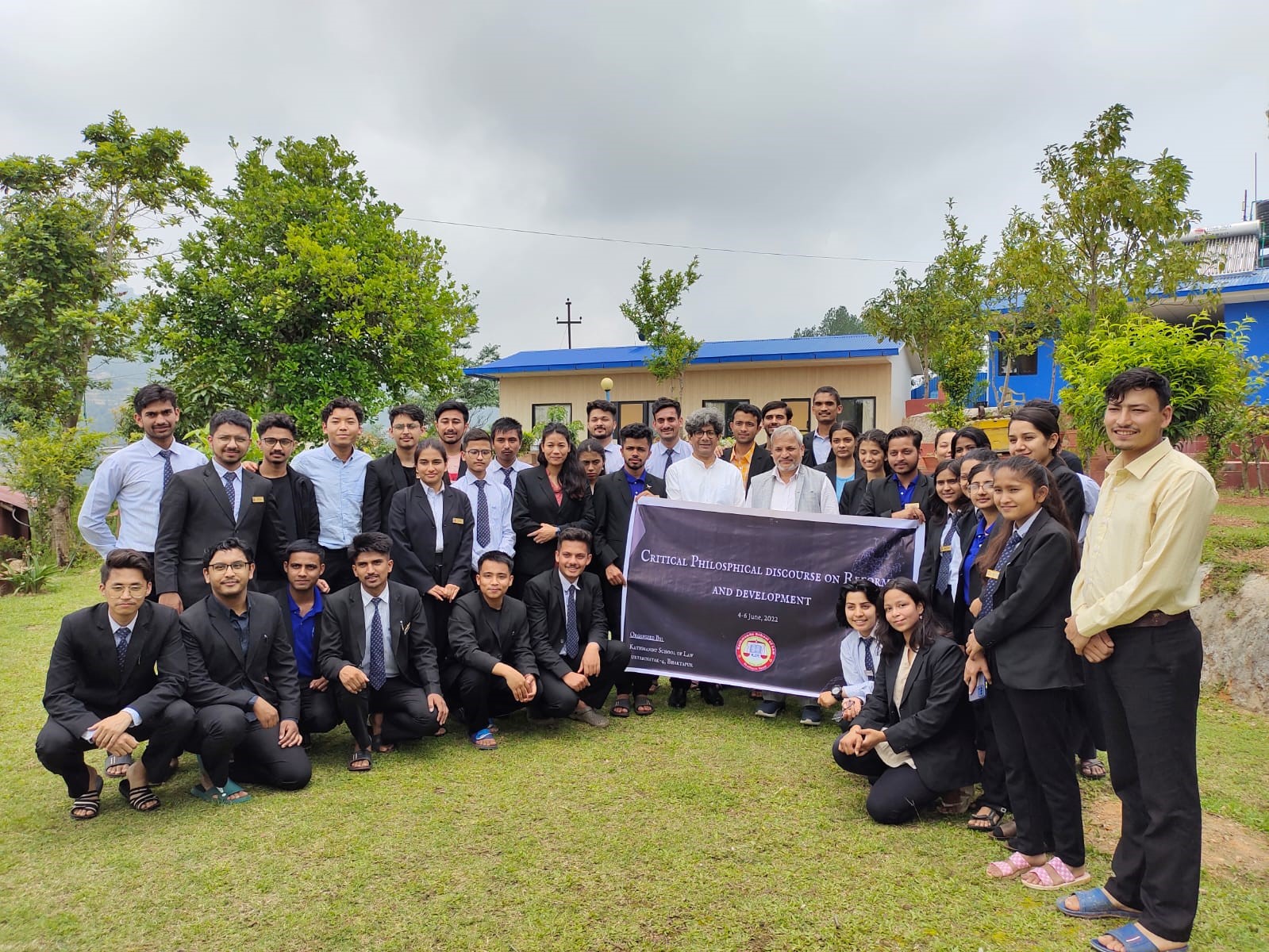
Youth and Enthusiastic students of Kathmandu school of Law voluntarily organized three days residential Program themed as “Critical Philosophical Discourse on Reforms and Development” which began from 4th June and marked an end at 6th June.
Objective:
There were total of 39 participants in the Discourse who were representing BA.LLb 1st, 2nd and 3rd year The major objectives of the Program was To make the students understand basics of philosophy and discuss their relevancies in Nepalese context and to facilitate in observing the socio-political and economic phenomena around through different lenses i.e., different philosophers and their understanding. Others objective were to internalize the importance of philosophy for betterment of state, to discuss on causes of failure of Nepal and the find out solution way forward through critical discussion and to motivate students who would conduct various Program on contemporary issues in and out of college premise.
To participate in philosophical discourse, selection process was mandatory. Interested through selection process were able to participate. Prior to residential Programme, few orientation classes at college premise were taken by Prof. Yubraj Sangroula. The orientation classes primarily focused on shedding light on renowned philosophers and their philosophies till date.
Students arrived at residential on 4 June morning. On 1 st day, Dr. Khagendra Prasai elaborated about the meaning of philosophy. He similarly discussed about the Branches of philosophy which are as: Ontology, Epistemology and Axiology. The class had rigorous discussion on two popular schools of Philosophy as well. Participants were found divided on preference of Materialism over Idealism and vice-versa. It was obvious though.
On same day, further class on “Kant and his concept of Idealism” was facilitated by Prof. Yubraj Sangroula. This class was the cherry on cake. Kant had a popular saying- “Knowledge is not experimental”. We were taught how Kant reached at such conclusion. We are also provided with why and how his concept can be challenged? Kant philosophy can be overlooked as: - Truth comes from fact. Individual facts are collectivized to form a collective fact. Collective facts are synthesized to form Forms and Essence. Forms are facts and the essence is the characteristic of the object. As per Marx, Forms determine the essence. Hegel has totally opposite understanding than Marx. The process of forming forms and essence from fact is called world view. World view are of two kinds, i.e., Synthetic concept and Pure Knowledge. Pure knowledge can further be classified as Hypothetical Imperative and Categorical Imperative. The Categorical imperative, which remains obligatory all the term is called to be “moral values”. Kant regards such moral values as Christianity (Bible).
On 2 nd day, we were facilitated with two of the most renowned professors of Nepal. Prof. Bed raj Gyawali emphasized on Buddha’s Life and his core teachings. We realized the importance of Buddhism as religion to enhance Nepal’s foreign relations with countries which follows Buddhism.
Prof. Arun Gupto shed light on sources of Knowledge, few to mention: Perception, Inference, Intuition, Authority, etc. perception is shaped as per information gained through sensory. Prof. Gupto perceives that perception limits our understanding of the world. Discussing about Authority, he delved into Socrates life and his philosophy. Socrates thought “Writing is the enemy of memory”. Prof. Gupto agrees with him. Listening about Dialogues between Thales and Protagoras, and between Socrates and Protagoras was really worthy.
On last day, we rigorously discussed on how “Guided Independence” of Nepal has led to failure of Nepal. We also discussed about ways forward to be adopted for prosperous and happy Nepal.